Concrete and steel construction
What are the key innovations shaping the future of precast concrete?

From BIM, virtual and augmented reality to robotics and even 3D printing, these innovations are gaining ever more traction in the construction industry and are gradually making their way into precast concrete production. What will building with (precast) concrete look like in the future? In a podcast by architecture website architectura.be, three experts from the production, development and architecture sectors shared their thoughts on this fascinating question.
Digitalisation is now an integral part of modern construction practice. This also applies to people and companies working with precast concrete. The fact that the underlying philosophies of off-site construction and innovative collaboration models such as Design & Build overlap is certainly an advantage, stresses Dirk Engelen, COO at Binst Architects. “In traditional construction, a limited proportion of additional costs is attributable to failures. BIM offers significant scope for optimisation to minimise these risks, and precast concrete can play an essential role in this. Construction team projects often seek added value by involving the contractor at a very early stage, which leads to greater efficiency. Precast fits perfectly into this picture.”
The ultimate aim is to make crucial decisions at the early stages, reduce construction time on site and minimise the number of building defects. However, BIM is still in its infancy in precast concrete production, although there has been a recent acceleration. “A lot of work is still done manually and on site, but there is considerable scope to automate production. BIM certainly offers substantial added value, particularly in terms of quality assurance,” stresses Sonja Kuypers, CEO at Ebema.

Robotics and augmented reality
Robotics, laser technologies, optical scanning, augmented reality … these innovations are also making their debut in the precast sector. “AR allows you to overlay information on the real world, such as complex construction junctions and specific installation instructions. This reduces the number of installation errors and the associated costs of rework,” says Vincent Kerkstoel, director at Groep Kerkstoel and chairman of Febestral.
Augmented and virtual reality are also valuable tools in dialogue with clients. For example, they make it possible to show the client a detailed, realistic picture of the intended end result at an early stage of the project, an ideal way to better justify design and construction choices. Dirk Engelen believes this development will lead to a new way of working with clients, engineering consultancies and contractors. “A virtual handover of the model, including technical installations, finishes, colours …, can be an important milestone in the construction process. Of course, this means that much of the design work currently carried out during the construction phase will shift to the early stages, allowing the construction process to move ahead at full speed.”
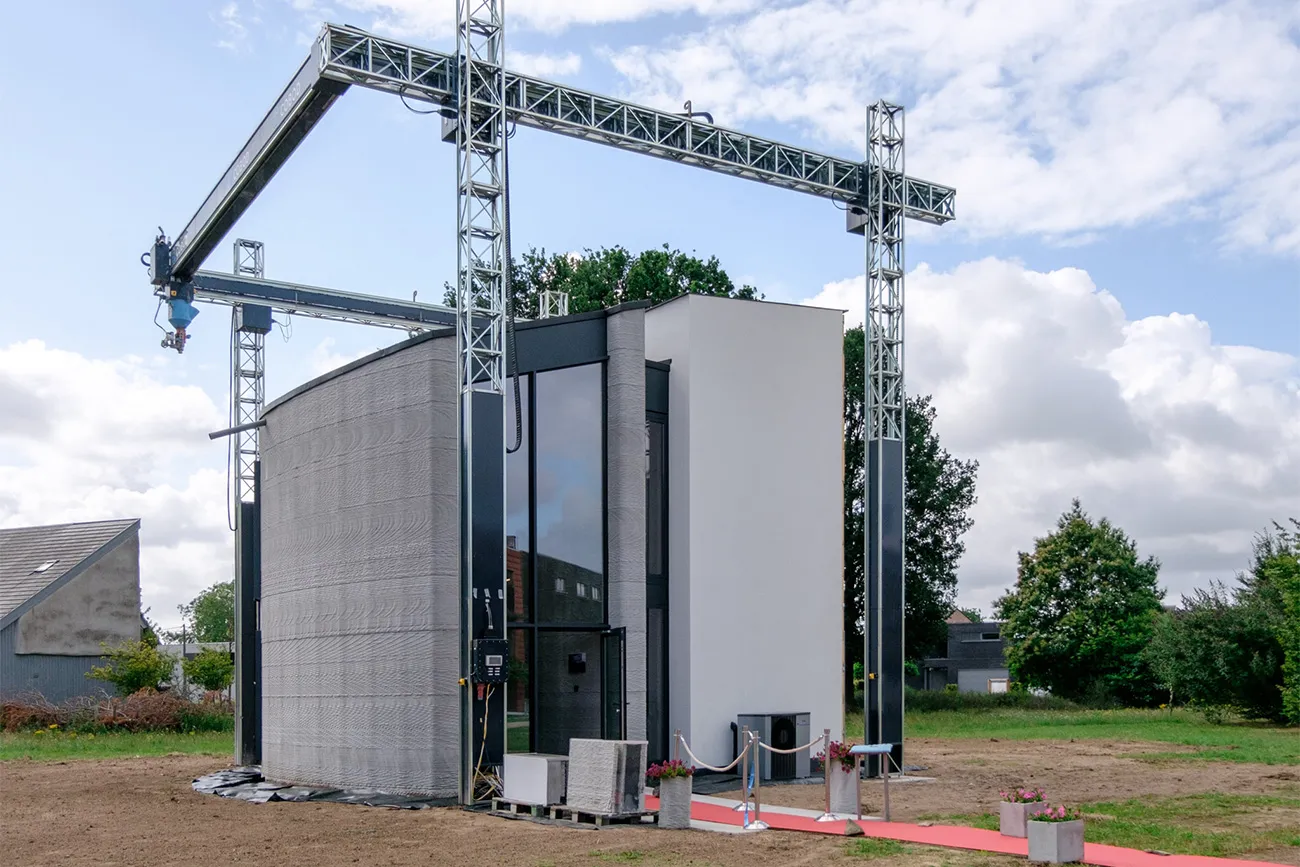
Is 3D printing the future?
Another significant innovation is 3D printing with concrete. In future, will more be printed than produced in the factory halls of precast concrete manufacturers? “It is a very impressive development, but I do not think 3D printing will completely replace the precast sector. At present, the technology is not ready for large-scale projects. In addition, on-site printing is subject to certain weather, environmental and quality factors that are much easier to control in precast manufacturers’ factory halls. Finally, certain elements are very difficult to ‘print’, such as large bridge components or elements for long spans. There are currently no ready-made solutions to the associated logistical challenges either. I do think, however, that specific printed elements could have a place within the wider picture. I also see potential in printing complex formwork for the production of precast concrete elements,” says Vincent Kerkstoel.

As an architect, Dirk Engelen does not yet see sufficient reason to adopt 3D printing on a large scale. “It is a viable alternative, but at present its scope is relatively limited. I have certainly not seen many 3D-printed applications that cannot be produced in another way. In any case, the pros and cons need to be carefully weighed up in the context of each project. The fact that it is a fascinating technology is not enough in itself. It has to offer genuine added value. I do see opportunities in creating complex shapes that are harder to produce using formwork. But I, too, see 3D printing more as a valuable addition to existing production and construction methods.”
Find out more
Want to know more? Listen to the architectura podcast ‘Precast concrete: what role does precast concrete play in a sustainable world?’. It is available via architectura.be or the usual podcast platforms (Spotify, Apple podcasts, Buzzsprout and Google podcasts).
Question about this story? Ask your question
Keep following this
Get an email when a new story is published. No account needed.
- SubjectConcrete and steel construction