“Digital tools facilitate the circular transition”
Text Tim JanssensImage Unsplash, KUBUS, Madaster
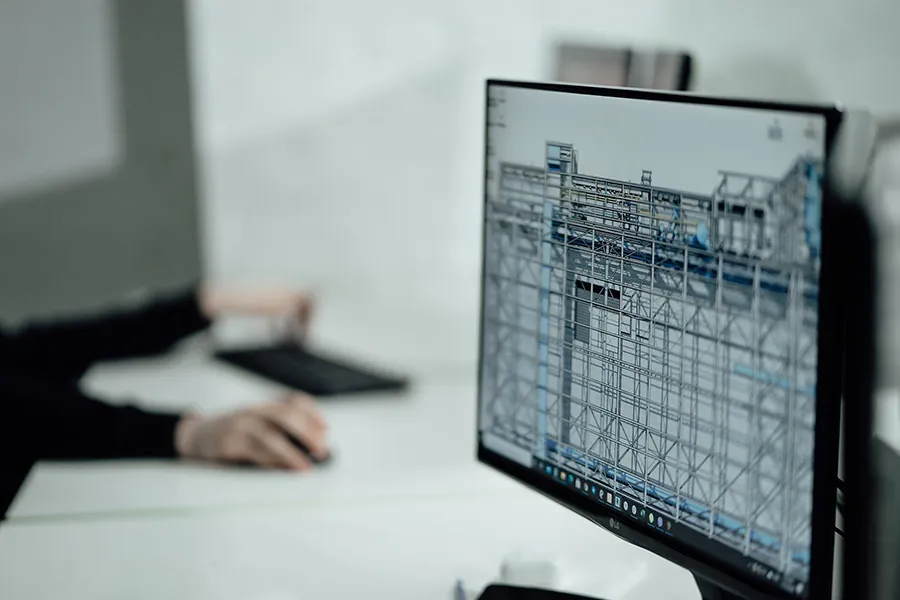
Circularity is the new building gospel, but during these pioneering years, making it practically feasible and economically viable is (still) no easy task. Fortunately, useful digital tools are available to support and facilitate the transition to circular construction. In episode 42 of the Architectura Podcast, Joeri Beneens (Beneens bouw en interieur), Véronique Orens (Yugening Architects) and Johan Klaps (Madaster Belgium) explain which software applications can add value in this respect.
Is extensive digitalisation an essential prerequisite for circular construction? Not necessarily, but it is an important supporting factor, they agree. “The only way forward is to keep track of all construction and material data, link it together and learn from it,” stresses Johan Klaps. Véronique Orens wholeheartedly agrees: “Circular thinking is by definition long-term thinking, because if a building is to be truly circular, it must still be useful in two or three hundred years’ time. So, as construction professionals, we must be willing to move with the times. In conventional renovation projects, we often have no or insufficient insight into the materials used, the load-bearing structure, the build-up … Digital tools can help with this and can also protect us from greenwashing, namely by enabling us to compare materials and systems using objective data.”
BIM and beyond
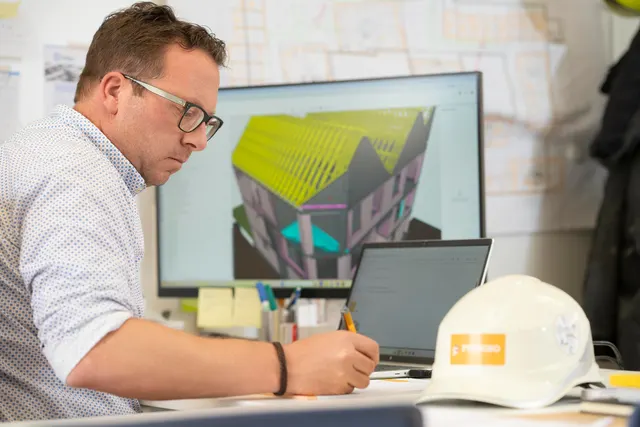
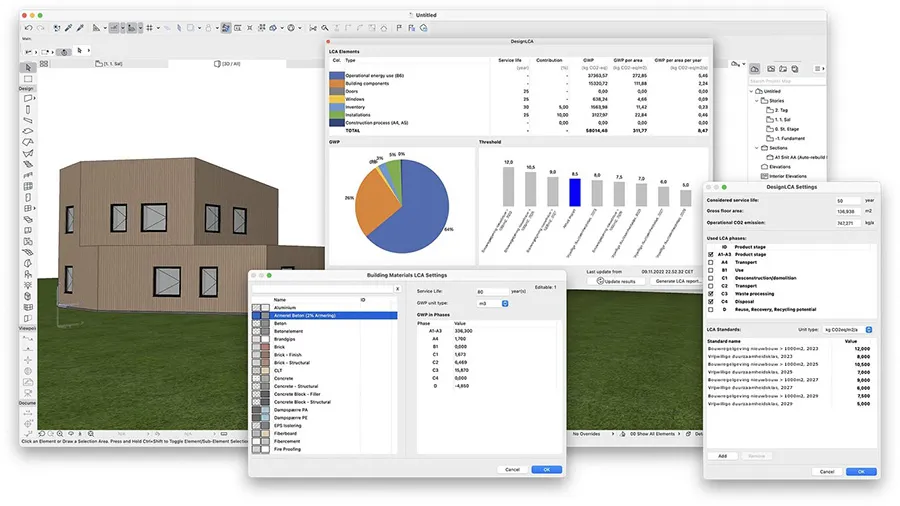
One digital tool that is now well established in the modern construction industry is BIM. But 3D modelling is certainly not the end point, stresses Véronique Orens. “Who knows, perhaps soon we will be talking about BAIM: Building Artificial Intelligence Modeling, where drones scan a building and project it into the Metaverse? It is difficult to predict what the next step will be, but digital evolution could give rise to a societal revolution that we cannot yet fully grasp. In the past, the upper floors of buildings in New York were the cheapest, until the lift was invented. This prompted a completely new dynamic, permanently changing the skylines of cities around the world. However, it is still anyone’s guess how BIM and related technologies will change the skyline of the construction industry.”
Material and building passports
Joeri Beneens emphasises that plenty of add-ons and extensions could further broaden the scope of BIM. “For example, we developed BIM-Integrum ourselves so that the BIM model can continue to be used once a building is complete. This led us to create a ‘passport’ containing all the materials incorporated in it, including technical data sheets and details of how they are assembled and disassembled, as well as a kind of circularity score, not only for the building as a whole but also for every component of the envelope. Each construction material is given a unique NFC tag, allowing it to be tracked across the years and between projects.” Various software applications are available for creating such material and building passports. “It takes a bit of searching, just as there used to be different video recorder systems. Product-specific information, EPDs, data on the valuation of materials (in my view, the real big revolution of the future) … the main challenge lies in gathering all the data, because technically everything is ready,” says Johan Klaps.
Ecology versus economics
Are material and building passports essential for circular construction? “Absolutely,” replies Johan Klaps emphatically. “You need to know what is where, what it is made of, what else you can do with it, how to remove it from a building, what its CO2 impact was when it was installed … In other words, you need to give materials an identity, because that matters when you later have to choose between a new or a reusable option. Such a passport is crucial to making use of the circular potential and assessing residual value.” The economics must also add up for circular construction to take hold, concludes Véronique Orens: “You might think economics and ecology go hand in hand, but in practice that is not so straightforward. I think it would be beneficial if a new digital tool were developed to keep everything affordable for private individuals. It is thanks to the digitalisation of buildings that ecology is increasingly becoming economics, and vice versa. When circular construction starts bringing in money, we will have made it!”
Want to find out more? Listen to the full episode of the Architectura Podcast at www.architectura.be/podcasts or on familiar podcast platforms such as Spotify, Apple podcasts, Buzzsprout and Google podcasts.
Question about this story? Ask your question
Keep following this
Get an email when a new story is published. No account needed.
- SubjectSoftware