Belgian company builds circular home in just six weeks
Text Marthe JansenImage CIRCL
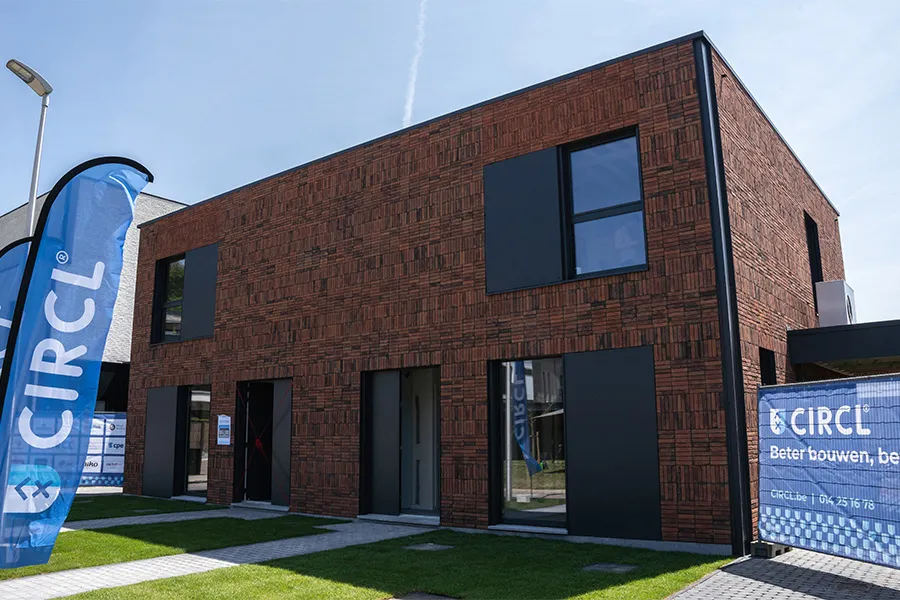
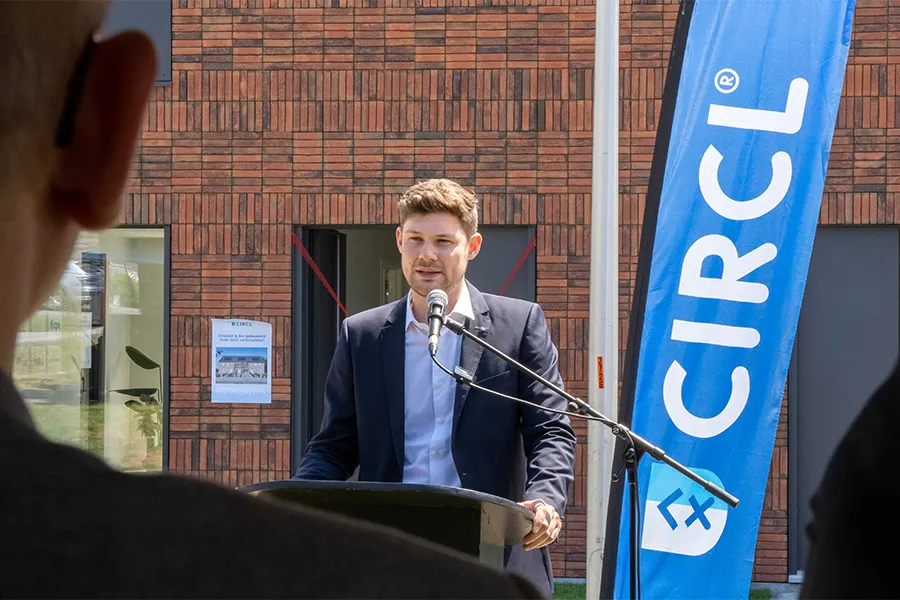
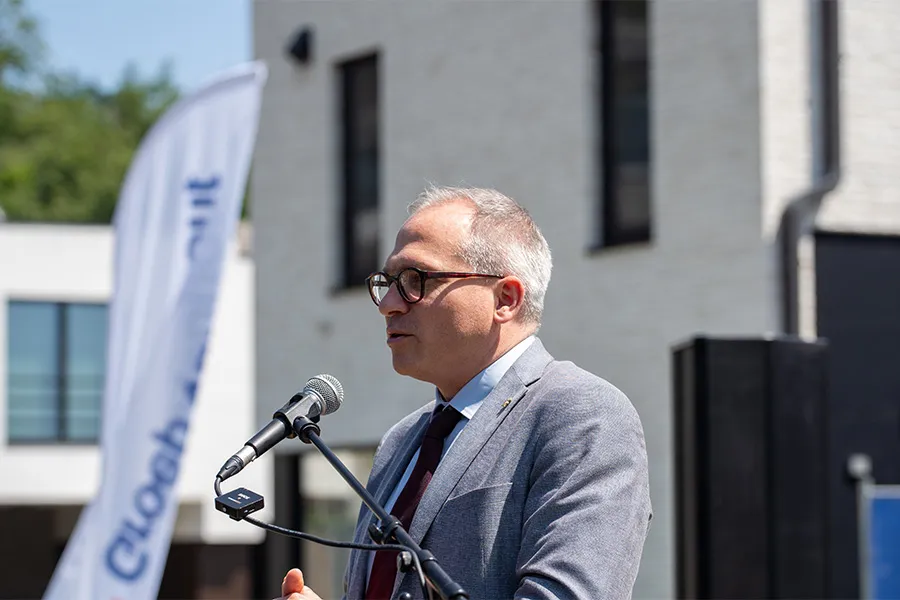
Build a circular home in just six weeks? CIRCL, a subsidiary of Groep Vanhout/BESIX, has done just that. The first two circular homes were unveiled in Diest on 1 June, in the presence of Flemish Minister for Housing and Immovable Heritage Matthias Diependaele. The company aims to make circular construction accessible to the general public by delivering affordable, bespoke, turnkey circular homes. Notably, the homes are not only demountable, but also consist of 75 % bio-based materials. CIRCL describes this as a Belgian first.
The Belgian has a brick in their stomach, and that does not look set to change any time soon. This has an impact not only on our wallets, but also on the planet. The construction sector is responsible for 40 % of CO2 emissions, 50 % of energy consumption and a third of water use. Not to mention its enormous consumption of raw materials and the vast quantities of construction and demolition waste it generates … Yet awareness of the problem is growing, and the sector is gradually transitioning to more energy-efficient and sustainable construction.
Potential for greater sustainability
However, a major sustainability shift in the construction sector remains elusive, as sustainable construction often comes with a higher price tag, particularly when the total cost of ownership (TCO) is not taken into account. CIRCL, a subsidiary of Groep Vanhout/BESIX, is now offering turnkey circular homes to the general public at market prices.
Flemish Minister for Housing and Immovable Heritage Matthias Diependaele is full of praise for the project, calling it ‘important for Flanders’. “We face a major challenge. More and more homes are needed. The construction sector has enormous potential to make our society more sustainable, and has already taken important steps towards circularity in recent years. This progress is essential given the challenges facing the housing market. On the one hand, we must continue to provide affordable, high-quality housing, while on the other, we must also focus on sustainability to meet our climate targets. Initiatives such as CIRCL can act as a catalyst for expanding and renewing our social housing stock.”
Circular, but affordable
CIRCL aims to bring about a major (r)evolution in the construction sector. “With CIRCL, we are making circular construction, in which materials are reused and retain their value, accessible and affordable to the general public for the first time. Our off-site construction concept is radically digital, sustainable, flexible and fast: customers receive a bespoke design and a fixed-price quote within a day, and the time from planning permission to handover is no more than six weeks. The initial cost is only marginally higher than that of a conventional home, but the TCO is considerably lower,” says CEO Wim Pieters.
No standard homes
CIRCL combines standardisation, industrialisation and flexibility, enabling the company to build quickly. The home’s core consists of a standardised staircase and the Litobox, which houses all the building services. The remaining components, including the walls, bathroom and roof, are manufactured off-site by a select group of carefully chosen regular partners.
Customers can choose from a range of options for a CIRCL home. This does not mean, however, that they have to settle for a standard home. Flexibility is also possible. Each home takes account of the customer’s wishes and the characteristics of the site. All this is made possible by a digital approach to both production and design. Using generative design software, customers can immediately see a visualisation of their home based on their choices and preferences.
Outstanding efficiency
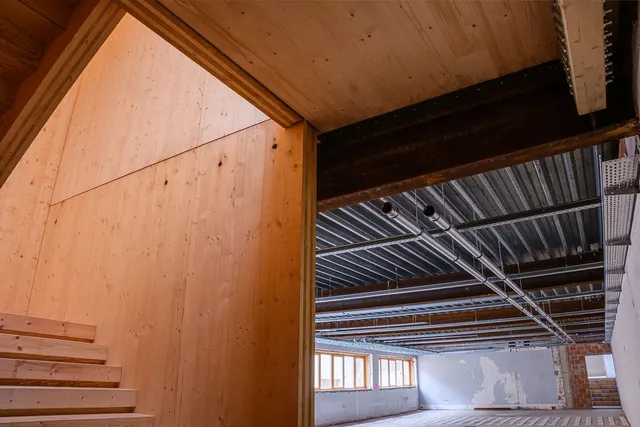
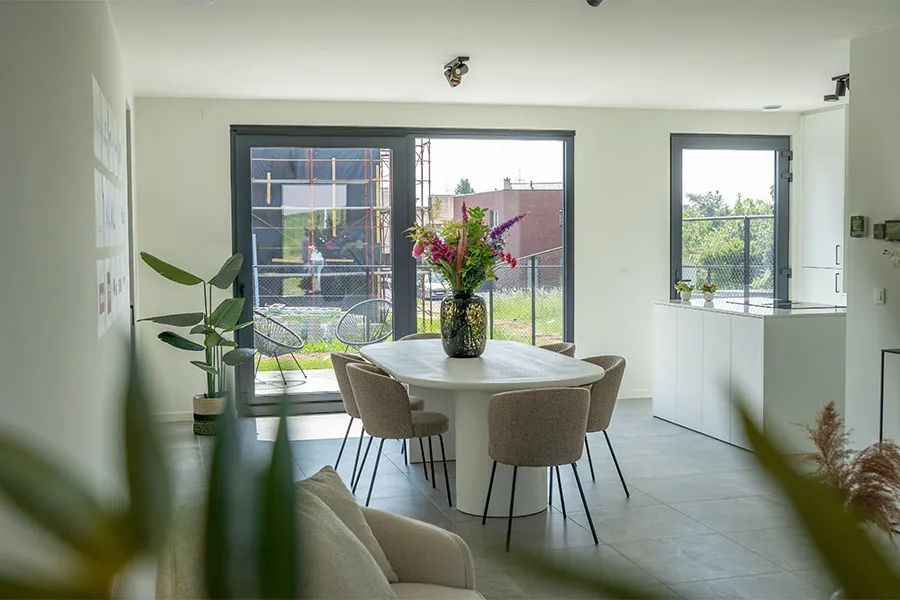
More than 70 % of the materials in the home are bio-based, and 40 % of the materials used are recycled. All materials are also attached reversibly. The home also uses less energy thanks to energy-efficient technologies such as a heat pump, solar panels and high-performance insulation. This approach minimises unexpected challenges and guarantees a fixed price.
“Every aspect has been carefully considered. For example, by using our compact technical module and smart wall systems, we gain 7 % net floor area compared with a traditional home. That amounts to an extra room. Because the homes are modular, they can also be easily dismantled or adapted, either to make them smaller or to add an extra storey. And all without wasting any materials,” concludes Wim Pieters.
The first CIRCL homes have now been sold, and several more are in the pipeline. CIRCL aims to sell more than a hundred homes a year in the longer term. In other words, watch this space!
Question about this story? Ask your question
Keep following this
Get an email when a new story is published. No account needed.
- SubjectSustainable construction