Sustainable construction through low-carbon glazing and glass recovery
Text and images Saint-Gobain Glass
The construction sector faces a major challenge: drastically reducing greenhouse gas emissions. Until now, the focus has mainly been on cutting operational carbon emissions, which arise from the energy used while a building is in operation. Increasing attention is now being paid to another, often underestimated source of emissions: embodied carbon.
Embodied carbon refers to the CO2 emissions associated with the production, processing and use of building materials throughout their entire life cycle, from the extraction of raw materials to the end of their service life. Buildings account for as much as 39 % of global energy-related CO2 emissions. Of this, 28 % comes from operational emissions caused by energy use for heating, cooling and electricity. The remaining 11 % is caused by the production of materials and construction itself.*
For architects, this means that the choice of materials plays a crucial role in making both new-build projects and renovations more sustainable. Whether insulating an existing building, replacing glazing or even renewing a floor, the impact of embodied carbon is lasting. Unlike operational carbon emissions, which can be reduced through energy renovations, once embodied carbon has been emitted, it cannot be undone.
Pioneering innovation in low-carbon glazing
Saint-Gobain Glass has embraced the challenge of decarbonisation. Thanks to years of investment in R&D, it has taken a revolutionary step since 2022 with ORAÉ®. This low-carbon base glass combines a high proportion of recycled material (at least 64 % according to ISO14021:1999) with the use of renewable electricity. The result? A sheet of glass with exceptionally low CO2 emissions of just 5.88 kg CO2 eq./m² (for a 4mm sheet of glass, stage A1-A3). This represents a 42 % lower environmental footprint than traditional float glass, without compromising on aesthetics, technical performance or quality.
For architects, ORAÉ® offers a practical solution for reducing the embodied carbon of projects while helping to build a circular and sustainable future. What is more, ORAÉ® is compatible with all Saint-Gobain Glass coatings and is available in a range of sizes and thicknesses, making it a perfect fit for diverse design requirements.
A step forward for sustainable construction projects
ORAÉ® is not only a pioneering innovation in low-carbon glazing, but is also officially recognised for its sustainability. The base glass is EPD-certified and has earned the prestigious Cradle to Cradle Certified® V4.0 Bronze label. This confirms its environmentally friendly production and ORAÉ®'s contribution to sustainable construction projects.
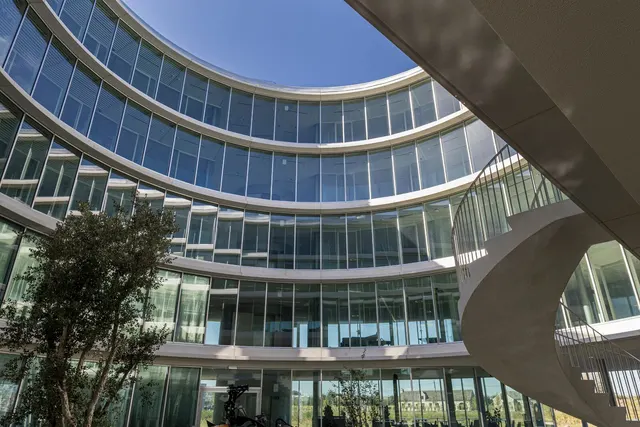
ORAÉ® also offers a significant advantage for architects and property developers aiming to deliver sustainable construction projects. Achieving certifications such as BREEAM and LEED becomes much easier thanks to its low embodied carbon and focus on circular principles. This makes ORAÉ® not only a sustainable choice, but also a strategic one for projects aiming to meet high sustainability standards. A case in point: for an office building with a 3000 m² glazed façade using laminated double glazing**, embodied carbon is reduced by no less than 81 tonnes of CO2 eq.
Glass recovery: taking sustainability further
Alongside the development of ORAÉ®, Saint-Gobain Glass is also investing in glass recovery. Old glazing is collected, recycled and reprocessed into high-quality glass. This process reduces the use of primary raw materials. 1 tonne of cullet saves 1.2 tonnes of primary raw materials.
“With ORAÉ® and our glass recovery programme, we give architects the tools to make sustainable choices without compromising on design freedom or quality,” says Saint-Gobain Glass. “By working together, we can drastically reduce the environmental footprint of buildings and contribute to a future in which sustainability is central. In three years, we have already supplied 35,000 tonnes of ORAÉ® and saved 17,000 tonnes of CO2 eq.”
**Based on glazing type 6#/16/66.2. The CO2 eq. calculation covers not just the glass, but the complete composition and production of the double glazing at stage A1–A3, including product loss inherent in the manufacturing process. Configure other compositions at Calumen.com.
Een zakelijke vraag aan Saint-Gobain Glass: Uw partner in innovatieve en duurzame glasoplossingen? Get in touch
Companies in this story
Keep following this
Get an email when a new story is published. No account needed.
- SubjectSustainable construction
- CompanySaint-Gobain Glass: Uw partner in innovatieve en duurzame glasoplossingen