A new lease of life for fire-resistant mortars
Fire-resistant mortars were long niche products, but in today’s construction industry they could play a much bigger role. Kris Vermeiren, managing director of supplier Pirobouw, explains how.
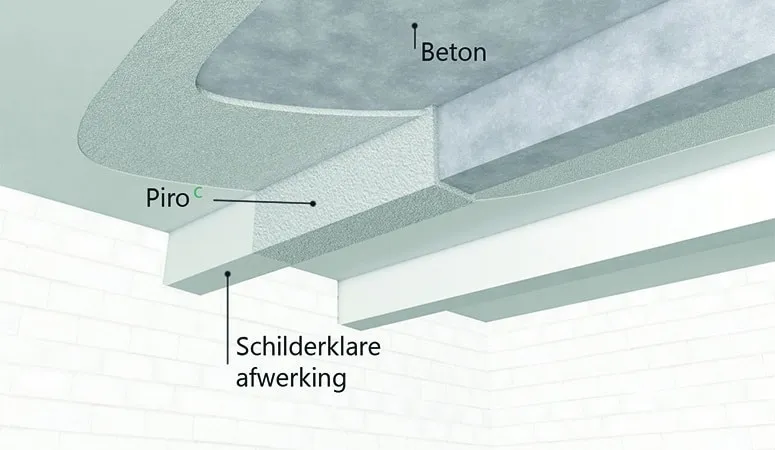
Pirobouw is part of insulation specialist Thiers-Horizon (Schoten), a specialist in mortars for the thermal and acoustic insulation of floors and roofs (Pirotherm, Isobet and Styrobet). Pirobouw’s own range currently includes two fire-resistant mortars for interior applications. Piro-s(teel) is designed for load-bearing steel structures. Piro-c(oncrete) has been developed for concrete walls, ceilings, beams and columns.
Remarkable test results
Wilfried Vermeiren, father of current managing director Kris, and Czech specialist Josef Cipin developed the basic versions of these mortars back in the 1970s. “At the time, the universities of Ghent and Liège were already conducting tests to determine their fire-resistant properties. The results were very favourable, but we did not really do much with them. Two years ago, under the new European regulations, we had to commission updated tests. Warringtonfire Gent and Efectis Nederland carried them out. The results were remarkable, with a REI rating of 120 minutes for an 8 mm layer of Piro-c. That is comparable to an additional 40 mm of concrete.”
Capitalising on the renovation trend
In recent years, Vermeiren has seen some interesting applications emerge. “Not only is there much more renovation work, but many existing office buildings in urban areas are also being stripped back and refurbished. If they were completely demolished and rebuilt, they would not always be granted planning permission to reach their original height. When stripped back, their floors and ceilings are retained, but they very rarely meet current insulation and fire-resistance requirements. Lightweight products with a low application thickness are ideal for bringing them up to the required standards. The same applies to fire protection measures on existing storeys. Traditional finishing materials need to be thicker, which can leave users and visitors with the impression that the ceilings are uncomfortably low.”
Easy to apply
Another advantage may be even more useful. “Other finishing products with fire-resistant properties are often so complex that only specialist companies can install them correctly. Anyone can apply Piro-c using conventional spray equipment. You just need to ensure that the protective layer is 8 mm thick everywhere. There is no need to apply a primer first.”
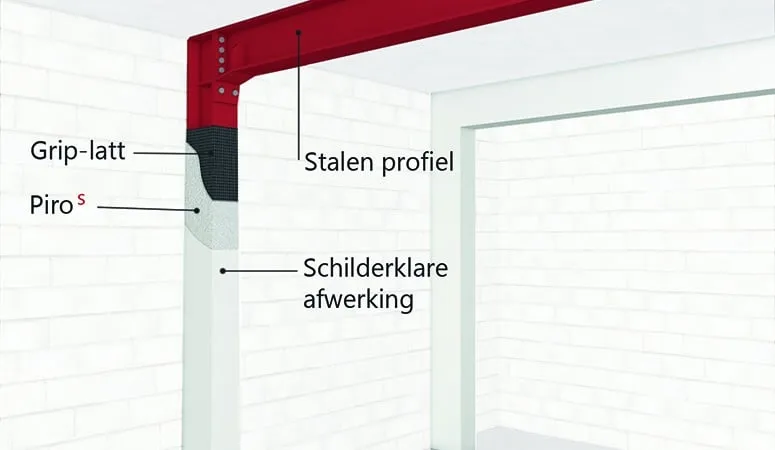
“For Piro-s, a 20 mm layer is required to achieve 60 minutes of fire resistance, and 35 mm for 120 minutes. For the final layer to adhere properly, the product must not be applied directly to steel beams. Griplatt reinforcing mesh is used as a substrate, with the beams wrapped in it first.”
Fibre-free
“Our fire-resistant mortars consist of a fibre-free blend of vermiculite, perlite and aggregates, with gypsum as the binder. This combination gives them their high fire-resistance rating and also guarantees outstanding mechanical strength. Unlike some other fire-resistant plasters, our products are hard-wearing and abrasion-resistant, so they do not crumble over time. Their fibre-free composition also prevents flocculation,” Vermeiren stresses. Both type c and type s can be painted.
Pirobouw works with certified installers for its mortars, but focuses mainly on selling them in easy-to-handle bags. We are not targeting wholesalers or other intermediaries, but want to reach end users directly. Given the digital options available today, this is no problem.”
Words: Koen Mortelmans | Image: Pirobouw
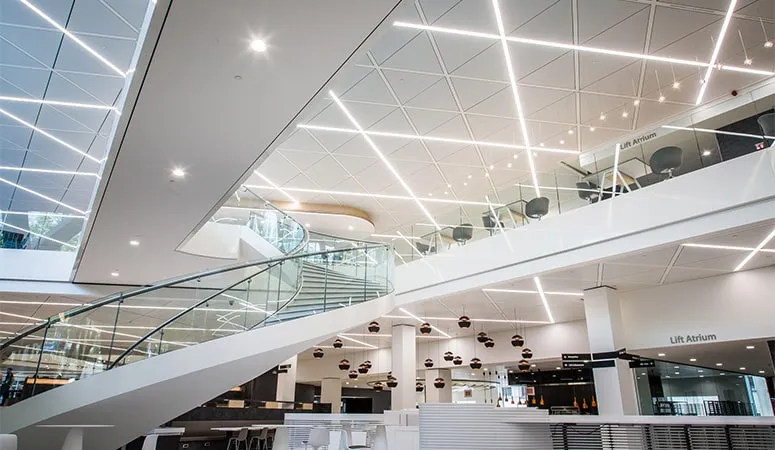
Featured image: The building contains a vast 4,000 m² inner courtyard known as the ‘Forum’. (Image: Wen-Chi Su)
Question about this story? Ask your question
Keep following this
Get an email when a new story is published. No account needed.
- SubjectThemes