How green roofs can contribute to biodiversity
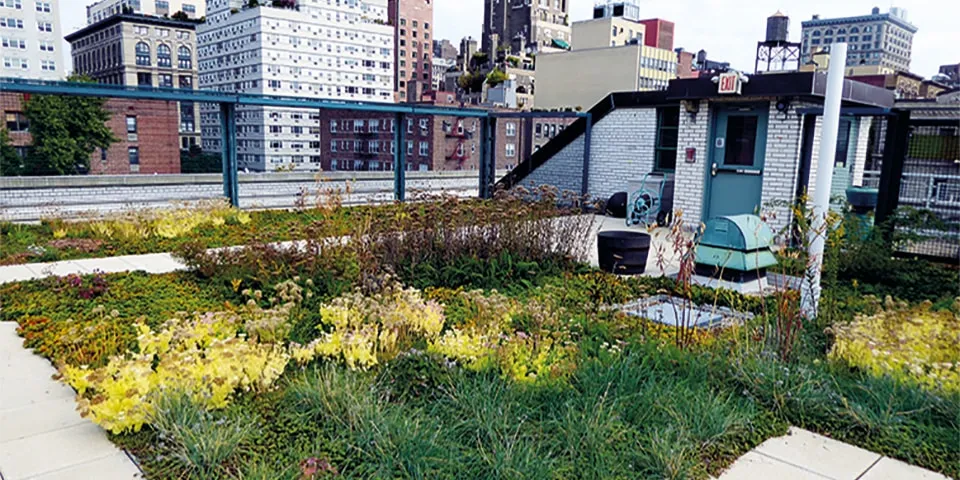
Alarming reports from the scientific community: insect numbers on our planet are falling drastically, to such an extent that, in the worst-case scenario, they will be completely extinct within a few decades. Green roofs and roof gardens could help turn the tide. “But we need to break the dominance of sedum and introduce variety into the planting if we want to promote biodiversity,” says American plant biologist Kelly Ksiazek-Mikenas.
The conclusions reached by Belgian scientist Kris Wyckhuys and fellow researcher Francisco Sànchez-Bayo, who analysed 73 studies on global insect decline, are almost as devastating as the living conditions of today’s insect populations: almost half of all species are in decline, more than a third are at risk of extinction, and if nothing changes, not a single insect will be crawling or flying around our planet within a few decades. Over the past 30 years, insect numbers have fallen by 2.5% each year, with butterflies and bees among the worst affected. One of the main causes is the widespread deforestation and urbanisation of our planet, which wipes out entire habitats and ecosystems in one fell swoop. “It’s a disaster,” say Wyckhuys and Sànchez-Bayo, “because insects are the foundation of our ecosystem, both on land and in water. They pollinate plants, vegetables and fruit, ensuring that we have food. If that were to stop, it could lead to serious problems.”
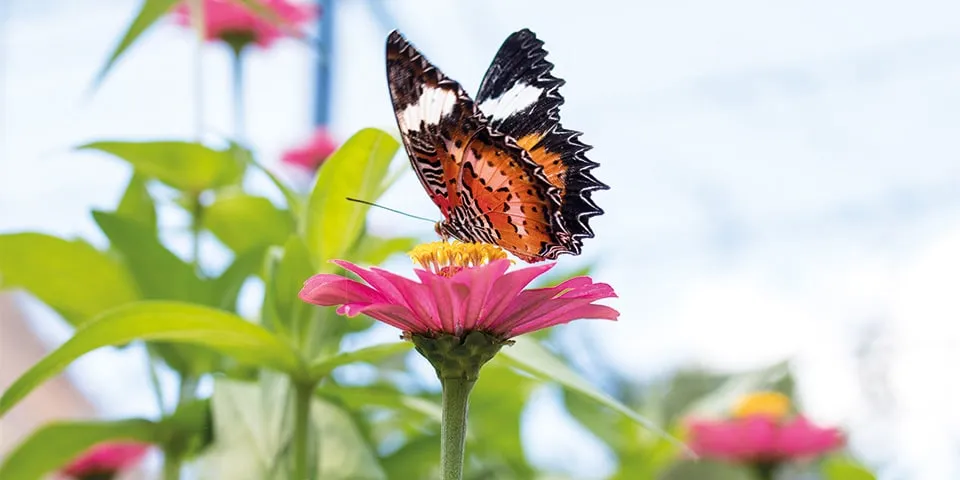
One possible solution for helping threatened insect species to thrive again is to create green roofs.
Not necessarily more biodiversity
One possible solution for helping threatened insect species to thrive again is to create green roofs. “If we were to turn the millions of flat roofs in our region into intensive or extensive roof gardens, we could give some of the built environment back to nature,” experts in the field regularly suggest. But does this also lead to greater biodiversity? “Not necessarily,” says American plant biologist Kelly Ksiazek-Mikenas, adding a note of caution. As part of her PhD at Northwestern University, she and German specialist Manfred Köhler studied sixteen green roofs in north-eastern Germany. These installations ranged in age from one to 93 years. The central question in the study was whether green roofs do indeed support a wide variety of plant and animal species over time, and whether biodiversity increases as the years go by.
The conclusion: the number of plants does indeed increase, but unfortunately this does not translate into a
rise in the number of plant and animal species.
More than just greening
In short, green roofs are no guarantee of greater biodiversity. This is especially true when they are planted predominantly with sedums, Kelly Ksiazek-Mikenas emphasises. “Sedums are a highly effective way of greening roofs, but if we really want to promote biodiversity, we also need to experiment with other plants and herbs, preferably native ones. That is the only way we can take urban ecology to new heights. In any case, it is advisable to choose as wide a variety of plants and herbs as possible, and then make the effort to keep any overly dominant species in check. It is also a great idea to install a few beehives and place some rotting wood here and there on the ground, so that insects can turn the roof garden into their new home. Simply greening a roof is not enough. Architects and green-roof companies must take responsibility and introduce variety into the planting to give biodiversity a much-needed boost!”
Question about this story? Ask your question
Keep following this
Get an email when a new story is published. No account needed.
- SubjectThemes