Leading the way…
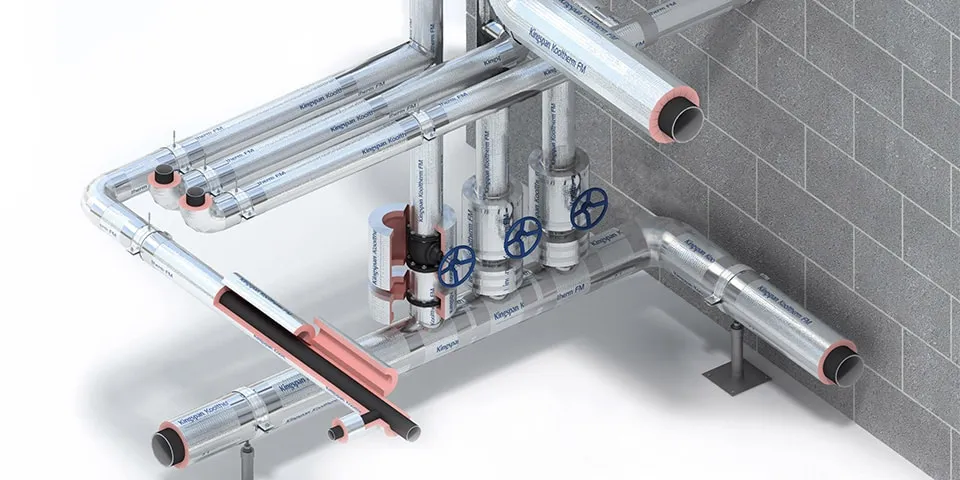
Installers have been using traditional materials to insulate pipes for years. Can these materials measure up against an innovative product such as Kooltherm®? “It is in the interests of both investors and users to keep the short- and long-term costs of pipe insulation as budget-friendly as possible,” says Wouter Steeman, Marketing Manager Technical Insulation at Kingspan Technical Insulation. “We have summarised the results and conclusions of several comparative field studies in a white paper, which demonstrates the benefits of Kooltherm® pipe insulation through a range of calculations.”
Leading manufacturer of pipe insulation products and systems compares widely used applications in a state-of-the-art reference project
Those investing in the construction of a building and its associated building services are increasingly confronted with rising heating and cooling costs. “In the coming years, decisions about energy and insulation will therefore move ever higher up the agenda,” expects Wouter Steeman. “This applies to engineers, consultants, contractors and installers, as well as building designers and owners, for whom these choices also have major implications. Just think of commercial buildings that are used 24/7. If heating pipes are inadequately insulated, too much heat may escape at the lowest level and rise, leaving the lower floors of the building too cold and the upper floors too warm. To prevent this, engineers, consultants and other stakeholders need to make well-considered choices. In our white paper, we examine an important aspect that can help not only to meet current and future standards, but also to keep energy and insulation budgets under control: insulating pipe systems.”
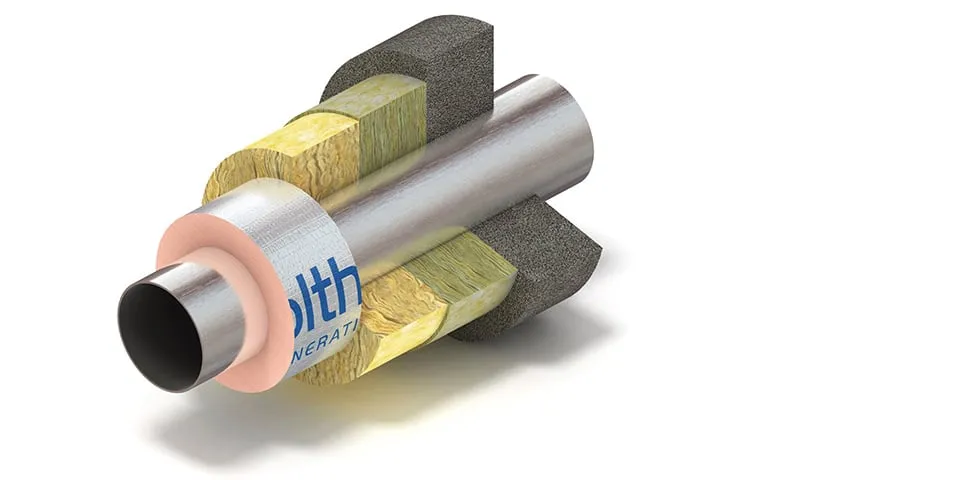
Kooltherm® pipe insulation has a thermal conductivity of 0.025 W/m.K.
Practical comparison
The white paper describes a state-of-the-art project in France, namely the construction of several buildings for the ‘Condorcet’ university campus in Aubervilliers (Paris). Steeman says this was a deliberate choice. “Kooltherm® was specified throughout this project, enabling us to compare our
pipe insulation in three (!) different applications: a central heating system, a cold water pipe system and a change-over (ATES) system. The project was also delivered in accordance with the EN 12828 standard. This sets out the design criteria for heating systems, particularly heat generation, distribution and emission systems. It distinguishes between different insulation performance classes, which specify the maximum permitted heat losses (0 = uninsulated, 6 = very well insulated). In Flanders, this insulation standard is set out in Typebestek 105. For this project, insulation class 2 or higher was specified for the insulation of hot pipes, while class 3 or higher was targeted for the cold water pipes and the change-over system.
The results
In Aubervilliers, Kingspan Technical Insulation compared Kooltherm® pipe insulation with mineral wool, PIR and flexible elastomeric foam. “We focused on installation costs, energy costs, insulation performance and payback periods. Our studies showed that the installation costs for insulating the entire pipe network to EN 12828 class 2 (central heating) and class 3 (cold water and change-over system) are significantly lower with Kooltherm® pipe insulation than with a combination of mineral wool and PIR. Operating costs are also much lower with Kooltherm®. Even if Kooltherm® pipe insulation is selected at one class above the specified level, total installation costs remain slightly lower than when traditional alternatives are selected at the specified classes. Choosing Kooltherm® class 3 and 4 also reduces heat losses further, resulting in lower annual operating costs. As energy prices rise, the savings will continue to grow.”
Kooltherm® pipe insulation makes it possible to insulate both hot and cold pipes with the same material. With a modest additional investment, the insulation class can be raised further to classes 4 and 5, says In ’t Veld. “According to the calculations, the payback period for this increased investment is less than a year. If the performance classes are raised to classes 5 and 6, the investment will be fully paid back in 3.8 years. Every year thereafter will bring pure energy savings.”
Optimum support
“Many clients and installers look only at material costs, but what they should really focus on is the payback period,” says In ’t Veld. “Installers also often reach for materials they have known for years. But development never stands still, in terms of technology or ease of installation. The best insulation is the result of several factors working together. To get the most out of it, you need not only to understand these factors, but also to apply them correctly. As an organisation, we are keen to play a part in this. We regularly give presentations to specification bodies, actively sharing the importance of the right pipe insulation and the benefits and installation of Kooltherm®. We also support installers and insulation contractors with the calculation and installation of our products, ensuring reliability and quality at
all times.”
Interested in the white paper? Visit www.kingspan-whitepaper.com or arrange a Lunch&Learn meeting with Jan Paeleman via [email protected].
Een zakelijke vraag aan Kingspan? Get in touch
Companies in this story
Keep following this
Get an email when a new story is published. No account needed.
- SubjectThemes
- CompanyKingspan