One year after the inferno at Notre-Dame: findings, lessons and conclusions
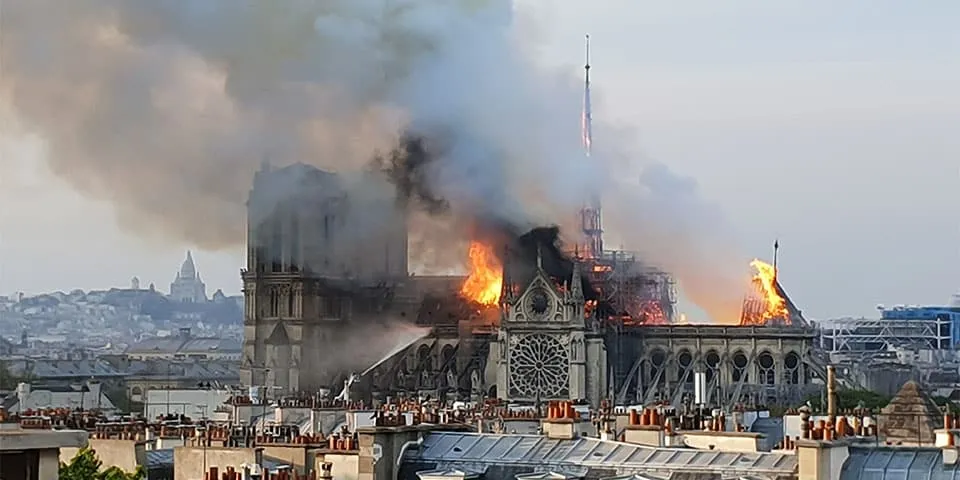
On 15 April 2019, disaster struck Paris. The iconic Notre-Dame, one of the French capital’s foremost symbols, was suddenly engulfed in flames. The monumental cathedral was reduced to a smouldering ruin in no time. Although the greatest danger has now passed, the devastating fire has left deep scars. What lies ahead for this battered Gothic masterpiece? And what lessons can we learn about fire safety in public and historic buildings?
A small short circuit or a glowing cigarette butt: that was all it took to partially reduce the famous Notre-Dame to ashes. To the horror of nearby Parisians, thousands of stunned tourists and art and history lovers from all over the world, white-hot flames and dusty smoke wreaked havoc inside the centuries-old cathedral, whose foundation stone was laid as far back as 1163. Storms, revolutions, world wars … for more than 850 years, Notre-Dame withstood every kind of disaster and catastrophe, but in the twenty-first century it proved no match for an ordinary fire. And this while it was in the midst of restoration, of all things. The irony …
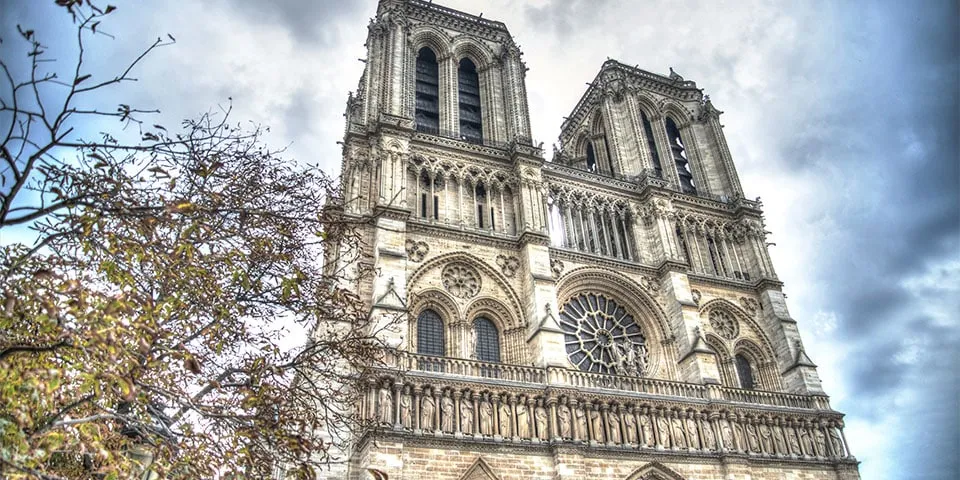
Notre-Dame will not be restored to its full glory until 2024.
Extensive damage
Only once the fire had been fully extinguished and the smoke had cleared from around the early Gothic cathedral did the scale of the inferno become clear. Around 20% of the building was destroyed, including the entire thirteenth-century oak roof framework. The central spire, designed by architect Viollet-le-Duc and added in 1859, also succumbed to the flames and collapsed beyond recovery. The mutilated Notre-Dame had literally and figuratively seen its proud appearance go up in smoke. “It could have been much worse,” experts said afterwards. “When
it collapsed, the spire created a large hole in the roof, which acted like a chimney. The smoke was drawn outside, saving many works of art. Miraculously, the organ and the world-famous stained-glass windows also survived.” Even so, the damage is enormous. The collapsed spire has left an unreal void, and the fragile vault of the Gothic masterpiece remains a constant concern, according to the restoration experts involved. The cathedral is once again caught in a web of scaffolding and will remain tightly constrained for years to come. Only in 2024, not coincidentally the year Paris hosts the Olympic Games, will the restored Notre-Dame once again be admired in all its glory.
Challenges, setbacks and obstacles
One thing is certain: the rehabilitation of Notre-Dame is a very long-term undertaking, and it has not been without its difficulties. Last summer, the work was delayed for the first time because measures had to be taken to prevent lead poisoning. During the fire, as much as 300 tonnes of lead from the spire and roof melted, posing a potential health risk to local residents. A few weeks later, autumn and winter storms also played their part. Whenever wind speeds exceeded 40 km/h, the site had to be evacuated for safety reasons. With the arrival of spring, there were hopes that work could finally begin on the urgent removal of the scaffolding that surrounded the nineteenth-century spire at the time of the fire. This tangled mass of tens of thousands of iron beams had twisted and fused in the heat, hanging over the interior like a sword of Damocles. Unfortunately, coronavirus and the associated ‘lockdown’ put paid to those plans. The cathedral had to weather the elements alone for a while, but work has since resumed and the so-called ‘cordistes’, construction workers suspended on ropes inside the cathedral, are gradually dismantling the structure. It is a delicate and spectacular task, particularly as it has to be carried out at a height of 40 metres. Several other stabilisation measures will follow, allowing the actual reconstruction of the cathedral to begin in January 2021. General Jean-Louis Georgelin, who is overseeing the work on behalf of President Macron, is confident that a Te Deum will once again be held at Notre-Dame on 16 April 2024.
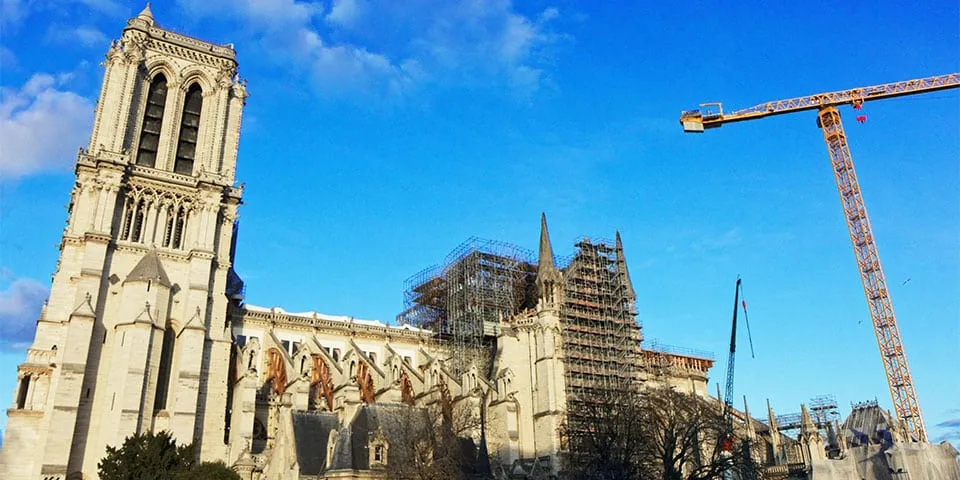
For the French, the reconstruction and restoration of the battered Notre-Dame is logically the ‘construction site of the century’.
A change of mindset is needed
Everyone agrees: what happened to Notre-Dame is a terrible tragedy. A fire is no disgrace in itself, as any situation involving electricity carries at least some risk of fire, but the fact that action was taken so late does raise a number of questions. It is an open secret that the cathedral’s fire detection system was not up to standard, meaning the blaze was only discovered after it had already caused considerable damage. As in many other public buildings, the fire detection system at Notre-Dame had not been tested adequately and was poorly maintained, with all the consequences that entailed. Fire safety is all too often seen as a burden and a cost, even though experience has shown time and again that it is not an area where you should cut corners. Olivier de Chalûs, historian and engineer and co-founder of the scientific advisory board involved in the restoration of
Notre-Dame, hopes that lessons will be learned from this catastrophe: “Many fire safety systems are designed primarily to get the people inside to safety, rather than to protect the buildings they are in. Sprinklers should be compulsory in churches with old wooden attics, so that they are activated immediately wherever heat or smoke is detected. It takes at least a quarter of an hour for the fire brigade to arrive. By then, it is usually too late …”
Question about this story? Ask your question
Keep following this
Get an email when a new story is published. No account needed.
- SubjectThemes