Ready for the smart home revolution?
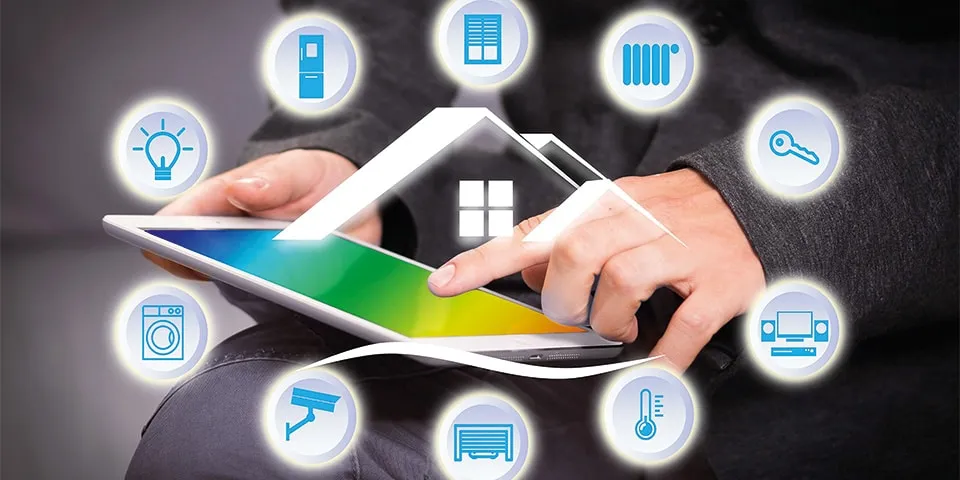
Smart homes are the next level in home automation. Technologies that until recently excelled mainly as standalone features are increasingly being integrated into homes that function as smart, unified entities. In this article, we take a brief but focused look at some of the major developments reshaping the market today. Because technology never stands still …
Controlling household appliances with mobile devices, voice technology, the Internet of Things: for a long time, these ideas seemed like science fiction, but these innovations are now having an increasing impact on everyday life. While older home automation systems managed to capture only a limited share of the market, the new generation seems to be gaining a foothold in the age of smart homes. The number of innovative applications is rising rapidly, while prices are moving in the opposite direction as supply increases and the electronics required become ever cheaper. Lower prices are in turn driving demand, creating a positive feedback loop. Experts agree: smart homes are on the verge of a major breakthrough.
Mobile and connected
As with demand for smart home automation and applications, developers and manufacturers have stepped up their efforts to innovate exponentially in recent years. This has led to the emergence of several interesting trends. Consider, for example, the importance of connectivity and mobile applications. Controlling your heating system remotely via a dedicated app or linking it automatically to your calendar so that it is nice and warm when you get home in the evening: smart thermostats can do this, and it is relatively straightforward, too. Often, all it takes is a connection to the home network to make the impossible possible. The emphasis on connectivity also allows smart systems to operate autonomously. A good example is roller blinds or curtains that open automatically according to the level of daylight. Rather than relying on expensive high-tech sensors to measure light intensity, these devices use information from specialist online sources. The alarm set by the user on their smartphone can also, of course, provide a key trigger. Then there is voice technology such as Google Assistant, Siri, Alexa and so on. Opening curtains, dimming lights or even making coffee by giving your home station a voice command is no longer science fiction.
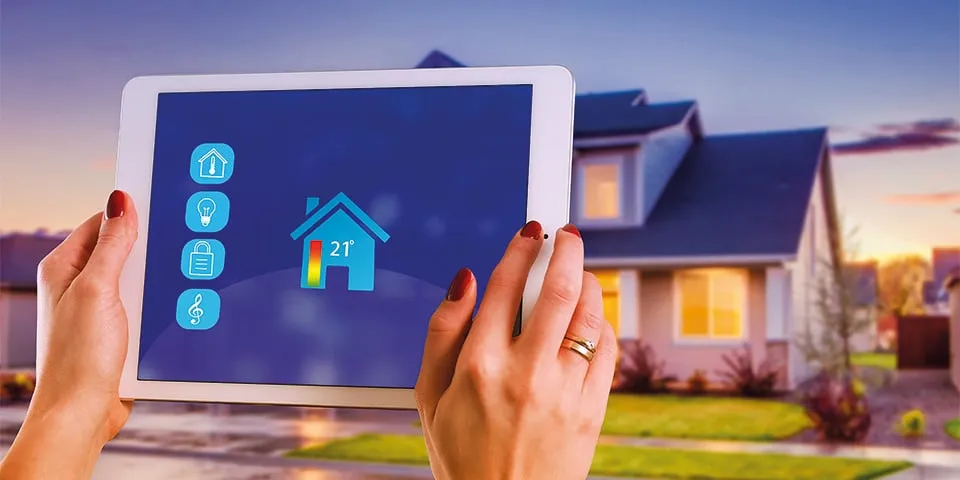
Controlling your heating system remotely via a dedicated app or linking it automatically to your calendar so that it is nice and warm when you get home in the evening: for a long time, this seemed like science fiction, but it is now relatively straightforward.
Towards a wireless world
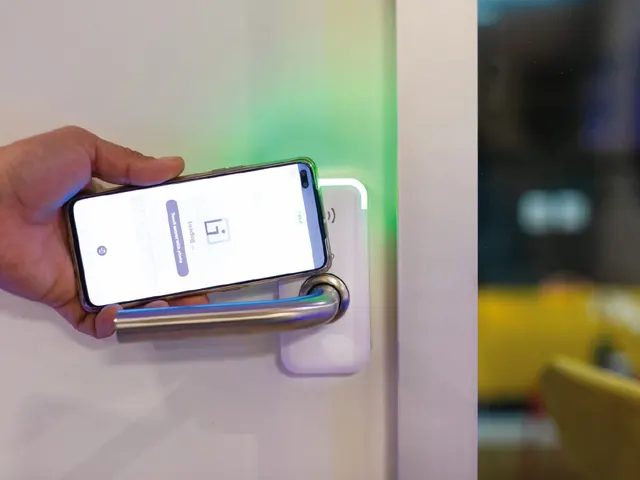
Cables, wires and conduits are increasingly a thing of the past. Wireless is the norm, and the market is responding accordingly. Smart systems that need only a Wi-Fi or Bluetooth connection to adapt a home’s operation to its occupants’ lifestyles, whether or not they use a central hub to synchronise different technologies, are springing up everywhere. There are also specialist applications that can help existing systems perform at their best by enabling conventional electrical components to communicate wirelessly with one another. This means that older homes, too, can be turned into connected smart homes without too much difficulty. Another advantage of wireless connectivity is the possibility of continuous monitoring by the manufacturer and/or installer. The devices are connected to a cloud server that continually logs their data output. If a problem occurs, it is recorded immediately and can be resolved efficiently, potentially even at the initiative of the manufacturer/installer and/or remotely. A technician no longer needs to visit the site to install updates or add new functionality.
Comfort versus security
As with any revolutionary development, the rapid rise of smart homes brings both advantages and disadvantages. As discussed at length above, smart homes enhance the comfort of residents and visitors by leaving nothing to chance. They also offer plenty of scope for personalisation, communication and monitoring. There are savings to be made, too, because connected electronic devices are used optimally and do not consume unnecessary energy. But there are also issues to consider. Privacy and data security remain sensitive topics, particularly because they are generally intangible and therefore difficult to control for smart home owners. Who has access to all that data, and what happens to it? How can smart homes be adequately protected against digital intruders? These are important questions, because hacking smart homes is no more a utopian idea than a home that functions almost autonomously. For now, security is the main obstacle to the definitive breakthrough of smart homes. However, this breakthrough is not expected to be far off. By 2020, an estimated 500 to 700 million smart homes are expected worldwide (figures from consultancy Gartner). It will be interesting to see how much our country contributes …
Question about this story? Ask your question
Keep following this
Get an email when a new story is published. No account needed.
- SubjectThemes