Study proves positive impact of acoustics on quality of life

The idea that good acoustics can improve quality of life has often been put forward. But is this actually the case, and if so, in what way exactly? The AcustiCare Project set out to find out in a two-year study into the effects of a balanced acoustic environment and the use of soundscapes in residential care homes. The results of this large-scale study look promising …
With life expectancy on the rise, healthy ageing is one of the greatest social challenges facing us in the years and decades ahead. Dementia is a chronic condition that can stand in the way. It affects cognitive abilities and can lead to psychological or behavioural problems. Today’s residential care homes make considerable efforts to provide people with dementia with a pleasant environment, but acoustics and the sounds in these settings have so far received (too) little attention. This prompted the Flemish Government to launch the AcustiCare Project, a practice-oriented study into the impact of acoustics on quality of life in residential care settings.
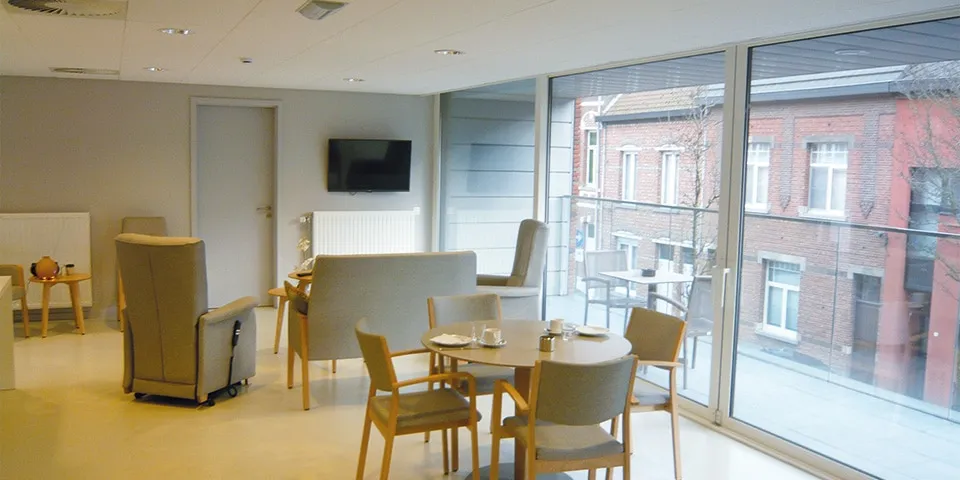
Reducing background noise also plays a crucial role in some residential care homes.
Acoustic improvements yield results
The research grew out of a productive collaboration between various stakeholders in elderly care, including knowledge centres (UGent, Arteveldehogeschool, Expertisecentrum Dementie Vlaanderen, WTCB …), construction professionals (Ibens, archipelago | ar-te and VK Architects & Engineers) and manufacturers of acoustic solutions (DOX Acoustics, Gyproc, ShowTex and Triplaco). Five residential care homes in Flanders opened their doors to enable an in-depth study of the effects of acoustic optimisation and the use of soundscapes: WZC Sint-Jozef in Lier (Amate), WZC Sint Vincentius in Meulebeke, WZC Leiehome in Drongen (vzw Sint Regina’s Godshuis), WZC Sporenpark in Beringen (Senior Living Group) and WZC Veilige Have in Aalter. The first step was to examine the number of sound sources, whether the living areas met acoustic requirements (room acoustics), and how they related to the adjoining rooms and spaces (sound insulation). The findings showed that poor acoustics can cause irritation among residents and staff.
In the next phase, sound-absorbing and sound-insulating solutions were installed where needed to reduce reverberation time, structure-borne sound and airborne sound. The results were positive: feedback on the acoustic improvements was very favourable. They had an immediate positive effect on residents’ behaviour and, thanks to their aesthetic qualities, also improved the overall atmosphere. In short, optimising acoustics does indeed improve quality of life in residential care homes!

Acoustic ceilings prevent disruptive reverberation in the living areas of WZC Ludinaca in Lanaken.
Soundscapes make a positive contribution
The second part of the study focused on the use of soundscapes. The ISO definition of the term reads: ‘The acoustic environment as perceived or experienced and/or understood by a person or group of people, in context’. This means that it is not only the sounds themselves that matter, but also how they are interpreted and experienced. In other words, distinguishing between ‘wanted’ and ‘unwanted’ sounds makes it possible to create an additional, positive dimension by deliberately introducing certain sounds, such as birdsong to wake up to peacefully, or music to energise people or help them relax.
Can soundscapes also help treat and/or manage behavioural or psychological problems? The AcustiCare Project suggests that they can. Since people’s responses to soundscapes are highly personal, they were developed through a co-creation process involving residents, families and staff. The residential care homes effectively served as living labs, where nature sounds proved far more popular than human or mechanical sounds, with the exception of bells or clock chimes, which were appreciated because they were so familiar. One important consideration, however, was ensuring that the soundscapes fitted in with the homes’ daily routines, which provide residents with an important sense of structure. Personal preferences must therefore be taken into account both when selecting sounds and when setting the time intervals. In short, reducing (disturbing) noise can go hand in hand with creating soundscapes, provided they are tailored to the setting and the people in it.
For more information, all the research findings and detailed analyses, visit www.acusticare.be.
Question about this story? Ask your question
Keep following this
Get an email when a new story is published. No account needed.
- SubjectThemes