Ten key points for urban policy in Ghent
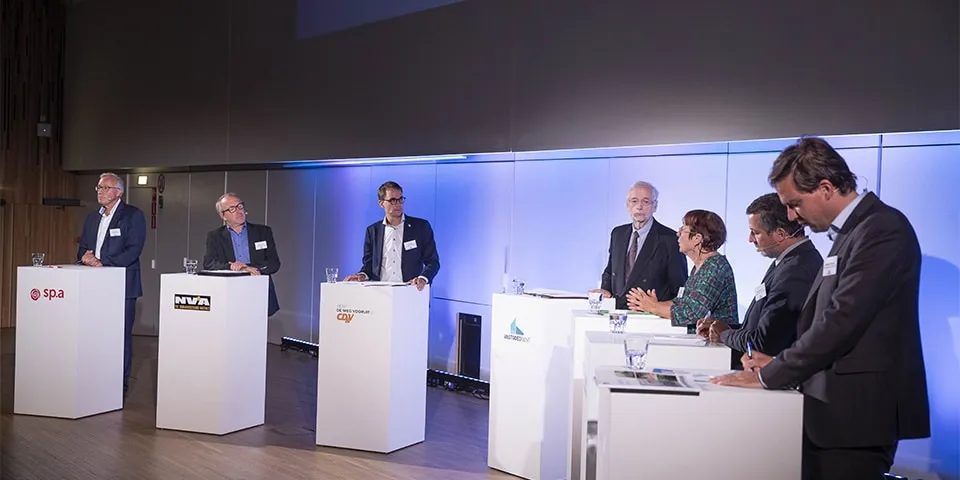
For Vastgoedevent 2018, the co-organisers from the construction and property sectors jointly drew up a ten-point programme for urban policy in Ghent. This programme provided the starting point for the election debate.
The ten-point programme highlighted the importance of a market-oriented approach and active involvement from the private sector. The advice to politicians was: “Engage in effective dialogue with businesses and the wider construction and property sectors. As a politician, remain accessible and ensure that civil servants do too. Always keep affordability and saleability in mind. Any requirement that does not meet market needs makes housing unnecessarily expensive. Amend the city’s general building regulations accordingly as soon as possible.”
The construction and property sectors also called on the city to introduce a transparent planning application process with realistic timescales, including at the pre-application stage. Anyone putting forward a project proposal should be able to count on clear, unequivocal advice from the municipal departments. Ghent must launch a new wave of urban regeneration projects as soon as possible, following the first wave twelve years ago. However, the development of urban regeneration projects must not be the prerogative of the autonomous urban development company. The time taken from developing an idea to its final delivery must be shortened. The city must also better align its investment programmes with those of other levels of government, particularly the Flemish Government.
The city should focus on “smart” densification: for example, adding storeys, making better use of apartment buildings, subdividing existing homes, adopting a policy that embraces different housing types (detached, semi-detached and terraced houses), and integrating living, working, shopping and recreation. The city council must no longer be so fixated on building so-called “ground-based” homes. The city should encourage households to renovate as much as possible, but also be willing to demolish, not only individual homes but also entire blocks and neighbourhoods. The city council must also take account of the crucial issue of accessibility, not only for residents but also for shoppers and employees. It must not restrict access by car if no alternative (bus or tram) is (yet) available.
Notably, in the audience survey at the event itself, 46% of participants gave the current collaboration with government a score of just 4 or 5 out of 9. More than three quarters (77%) felt there was still scope in Ghent for homes that are both liveable and affordable. As many as 41% felt that access to Ghent had deteriorated so much that customers and employees were avoiding the city.
Keynote speaker Geert Moerman, managing director of Voka Oost-Vlaanderen, urged politicians to show greater ambition. Economic growth is a low priority not only in urban policy but also in election programmes. The election debate covered topics including (more) social housing, the role of the urban development company, whether or not to allow additional storeys, omni-mobility (accessibility by public transport, bicycle and car) and a (thorough) approach to the nineteenth-century belt.
Question about this story? Ask your question
Keep following this
Get an email when a new story is published. No account needed.
- SubjectThemes