Revolutionary thermal break celebrates its 40th anniversary
Text Wouter PolspoelImage Schöck
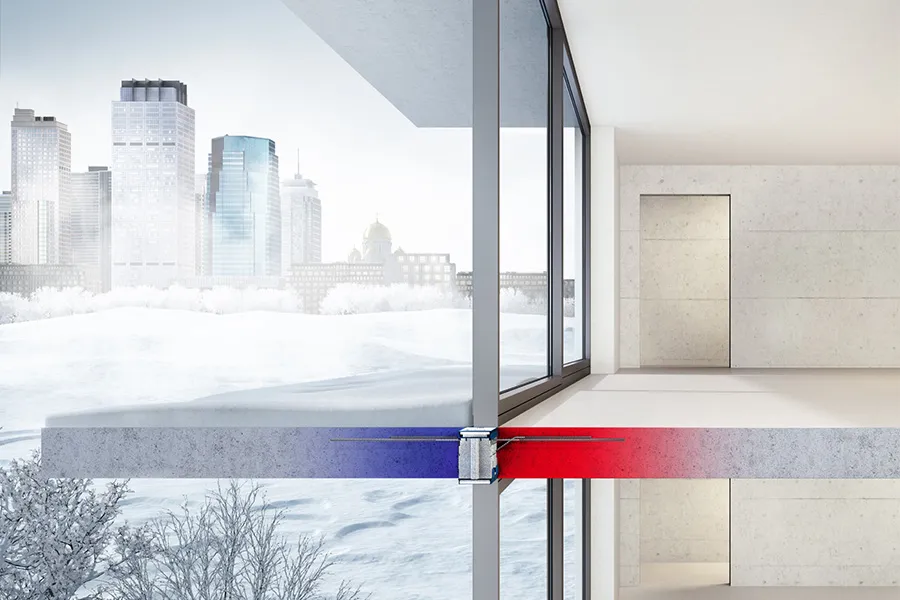
This year marks 40 years since Isokorb® came onto the market. At the time, Schöck’s innovative, straightforward solution for preventing thermal bridges through thermal breaks was a true revolution in the construction sector. Today, it has become an indispensable part of building. And to think that its inventor had his eureka moment during a skiing holiday in the Swiss mountains.
The skiing holiday that changed everything. The late German engineer Eberhard Schöck would probably not disagree if we described his week-long family skiing holiday in Zermatt, Switzerland, around Christmas 1979 in those terms. Here’s why: at the holiday home, the man who had set up his own construction company, Schöck Bautrupp, now Schöck, in 1962, noticed mould on the ceiling. He soon realised that the cause was uninsulated concrete balconies attached to the building at the same level. While still on holiday, he made his first sketches of a solution to prevent the problem. The following year, Eberhard Schöck applied for a patent for his groundbreaking idea and in 1983, after four years of development, the solution was launched with the necessary technical documentation: Isokorb®, an insulation element for minimising thermal bridges in cantilevered reinforced concrete components. It was a true revolution in the construction sector.
Numerous product innovations
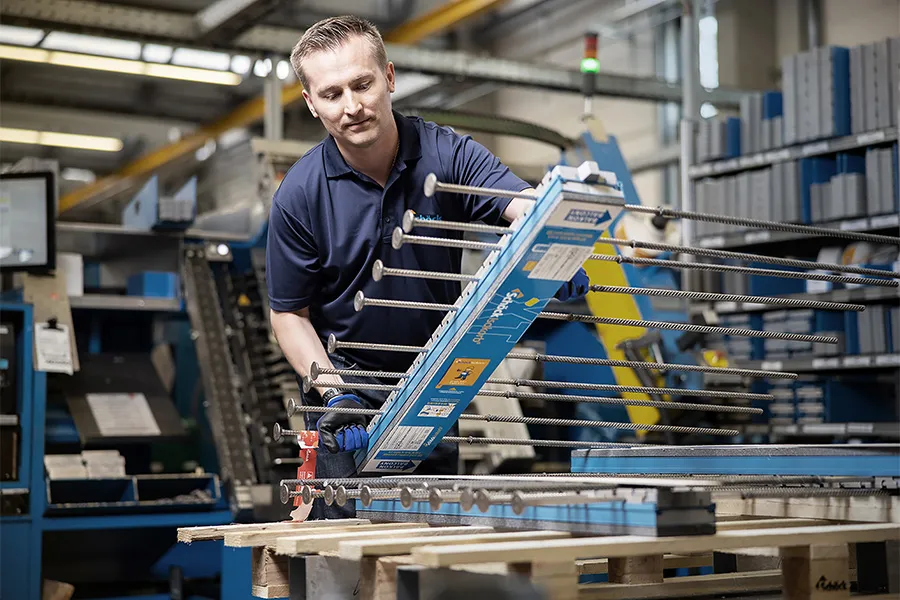
Numerous product innovations followed over the next few years. These included increasing the insulation thickness from 50 to 80 mm, replacing the steel compression bearing with one made of ultra-high-strength concrete to increase load-bearing capacity and thermal insulation while making installation easier, and incorporating the high-performance glass fibre composite Combar into Isokorb® as a thermally superior alternative to reinforcing and stainless steel. Other important innovations included the development of relevant digital tools, such as CAD/BIM libraries for Isokorb® and calculation programmes for selecting the right Isokorb® types or calculating the insulation quality of a balcony connection or roof parapet in just five steps. All this has undoubtedly paid off: today, this structural anchoring system, which thermally separates building components, now including steel components, to prevent thermal bridges, is an indispensable feature on building sites.
More specifically, Isokorb® is now sold in around 40 countries and is used in the construction of cantilevered or supported balconies, loggias, access galleries, canopies and roof parapets, in both new-build and renovation projects. In addition to standard applications, Isokorb® can also accommodate individual and complex installation situations, such as unusual geometries, long cantilevers or the construction of hybrid buildings.
Durable, straightforward and cost-effective
“The invention of Isokorb® is one of the most important milestones in our company’s history,” says Mike Bucher, CEO of Schöck. “Today, it is just as innovative as it was then and embodies the standards we set for the development of our entire product range: forward-looking, durable, safe, easy to install and cost-effective. Over the coming years, we want to make Isokorb® even better and more innovative, so that we can continue to meet market requirements with confidence.
Een zakelijke vraag aan Schöck België BV? Get in touch
Companies in this story
Keep following this
Get an email when a new story is published. No account needed.
- SubjectSustainable construction
- CompanySchöck België BV